




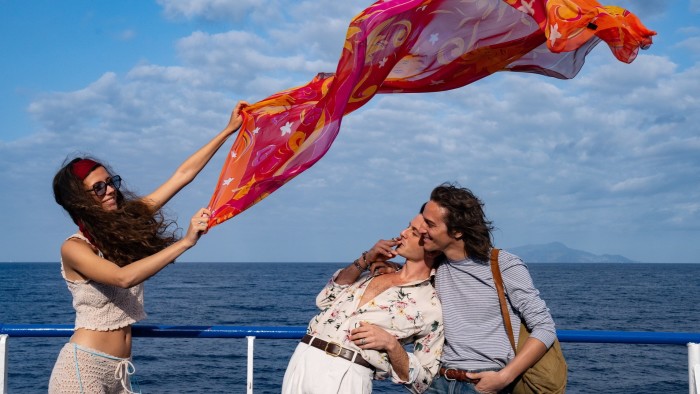
Summarize this content to 2000 words in 6 paragraphs in Arabic Stay informed with free updatesSimply sign up to the Film myFT Digest — delivered directly to your inbox.Paolo Sorrentino’s Parthenope is named after the siren of Greek mythology, sometimes considered the personification of Naples. The correct pronunciation is “Par-the-nopi”, but even diehard Sorrentino fans might see the final syllable as an emphatic “Nope”.The Italian writer-director undeniably has a genius for lavishly spellbinding imagery, as witness 2013’s flamboyant Fellini update The Great Beauty, which more than lived up to its title. But for all his brilliance, Sorrentino is an erratic, self-indulgent filmmaker, dangerously prone to mannered self-parody; and his latest confection is a chic, sumptuously self-important bore. It is set, mainly in the 1970s, in Naples, where the siren’s latter-day namesake (Celeste Dalla Porta) is born to wealthy, exquisitely depressed parents. Growing up, she is considered exceptional for her magnetism — even in a city where countless beautiful women are seen floating through the streets in slow motion, causing young men to contort in agonised adoration, similarly slo-mo.Men fall helplessly for Parthenope, including her own brother. But she is for the most part regally unavailable and amused by everything, forever shooting knowing smiles at the camera. Well might she be pleased with herself, as people constantly tell her she is brilliant and witty — not that there’s anything in her dialogue to corroborate this, despite the odd lost-in-translation aperçu (“Don’t you find that desire is a mystery and sex is its funeral?”). She is also supposedly a gifted anthropologist, although the only academic research she appears to do involves getting kitted up in skimpy episcopal jewels and dallying with a very carnal cardinal.Sorrentino is a notorious devotee of female beauty, in an unreconstructed moustache-twirling way. At one point, a helpless admirer sniffs Parthenope’s discarded bikini in rapture, which in effect is what Sorrentino does in cinematic terms; he’s evidently got it bad for his heroine — and his star. When he gives us a close-up of cigarette smoke drifting over her bare foot, it’s the film’s one genuine moment of erotic invention.Narratively, Parthenope is a sprawling mess of off-the-wall digressions, such as the sudden appearance of a monstrous, Sophia Loren-esque diva (Luisa Ranieri); and a touristic detour through the city’s grim, impoverished backstreets, only serving to highlight the Condé Nast Traveller glossiness of the rest. Gary Oldman briefly turns up as the American writer John Cheever, exuding etiolated weariness as he tosses off jaded bons mots in an exaggeratedly English accent (“Have you noticed how young people always opt shamelessly for despair?”).Dalla Porta certainly excels at being radiantly enigmatic; but she doesn’t have the remotest chance to create a character, for Sorrentino’s Parthenope is merely a shimmering cliché of the Eternal Female. All the director’s trademarks are here: languorously melancholic music; the usual imagistic mix of the gorgeous, the grotesque and the goofy; magnificent cinematography (Daria D’Antonio), especially in the seascapes; and fabulous production values, including costumes by Saint Laurent’s Anthony Vaccarello (also a producer here). The result is an exalted yet hollow art-house throwback to 1970s Euro soft-porn — luxurious kitsch that might just as well have been called Emmanuelle Gets Mystical.★★☆☆☆In UK cinemas from May 2