


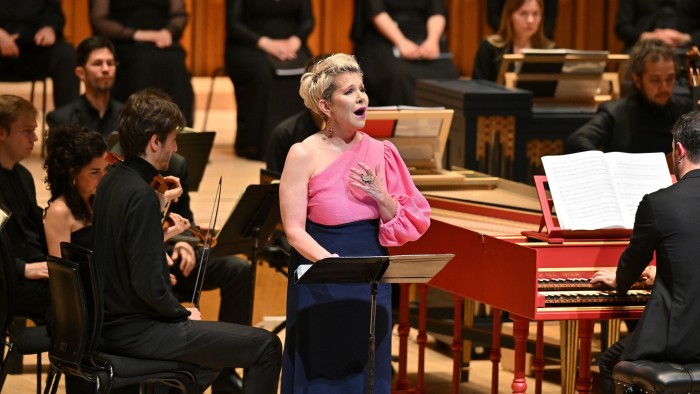
Summarize this content to 2000 words in 6 paragraphs in Arabic Unlock the Editor’s Digest for freeRoula Khalaf, Editor of the FT, selects her favourite stories in this weekly newsletter.It was only last season that there was a new production of Jephtha at London’s Royal Opera House. With Glyndebourne reviving Saul again this summer, it is easy to forget that Handel’s oratorios were never intended to have staged productions with scenery and costumes.In his day, oratorios knew their place. Written for the period of Lent, when theatres were closed, they offered a substitute for opera-going audiences in the form of “sacred dramas”. A concert performance, of the kind given here by period-instrument group Il Pomo d’Oro, is more what he would have expected.The presence of two singers with big careers in the opera house afforded something of a compromise in style. It would be hard to imagine a Jephtha writ on a larger scale than American self-styled “baritenor” Michael Spyres. He seems to sing almost everything from Baroque to Wagner these days (Die Meistersinger von Nürnberg is coming up at Bayreuth this summer), and his Jephtha embraced, on one level, fairly fluent coloratura and, on another, an operatic grandeur of utterance. Jephtha’s realisation of his error in committing his own daughter to death is one of Handel’s greatest achievements in oratorio and it came over with impressive stature here.The other notable singer was Joyce DiDonato, who was so inspiring in Theodora, another Handel oratorio staged recently at the Royal Opera House. The role of Jephtha’s mother Storgé plays second fiddle to Jephtha himself, but DiDonato filled each of the arias with such a range of colour and emotion that it did not feel small at all. Her special gift comes in the luminous arcs of sound that she traces in the air through slower music, making outbursts of a dark, more dramatic mezzo voice the more unexpected and effective.That also meant she was well contrasted with the other mezzo, Jasmin White, an incisive, swashbuckling Hamor. Mélissa Petit has a nice baroque sound for the innocent daughter Iphis, but with bigger, richer voices around her it was not heard to best advantage. Cody Quattlebaum made an imposing Zebul — he and Spyres were clothed in voluminous black Old Testament cloaks — and Anna Piroli shone brightly in the Angel’s dea ex machina appearance.Il Pomo d’Oro is an expert ensemble, its excellent choir of 17 around the size Handel would have had (though his would have been all men). With conductor Francesco Corti, a frequent collaborator with DiDonato, both lively and expressive, there was little not to like.It is an irony that Handel’s oratorios can come across more dramatically exciting in the opera house than many of his operas do. Conversely, there is an argument to be made for just concentrating on the music, especially when it is as rich in musical pleasure as this.★★★★☆barbican.org.uk