

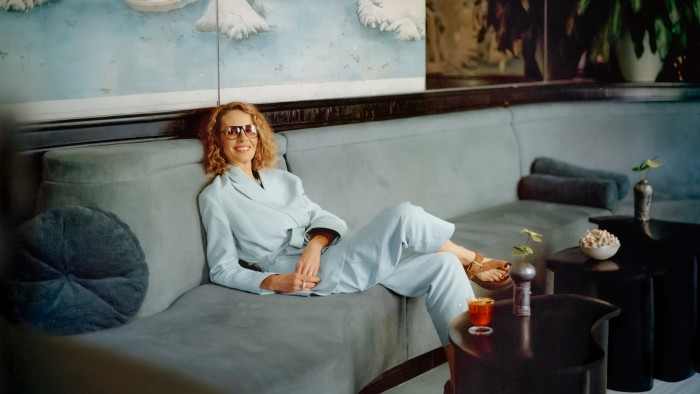
Summarize this content to 2000 words in 6 paragraphs in Arabic Unlock the Editor’s Digest for freeRoula Khalaf, Editor of the FT, selects her favourite stories in this weekly newsletter.I remember arriving in Mexico City very vividly. It was a Sunday – 11 November 1984 – and my dad, who was a very loving, strict man, took us to school the next day. That was my first connection to the country. I loved it.I was born in Colombia to a Colombian mother and an Italian father, and we travelled around a bit – living in Paris and Buenos Aires – before settling here. I consider myself Mexican; I’m married to a Mexican and I have Mexican kids. But it took me a while to understand what Mexico was to me. My school, the French Lycée, didn’t teach Mexican history or geography. I made up for that when I became an adult; then it was very much about understanding the country, its complexities, the landscapes and social aspects.When I met José, my partner, I started hanging out with his friends, many of whom were artists. It was like a new world had opened up. Gabriel Orozco, who was already quite a well-known artist then, said, “Why don’t you open a gallery and represent me and all our friends?” The landscape for contemporary art in Mexico City was pretty deserted then. Most of the energy revolved around artist-run spaces, not so much museums or galleries. “Let’s risk it all,” we said. Downtown is a place where jewels can appearThe first show happened in Mercado de Medellín. We rented the frutería for a day, and all of the works responded to the materials of the market – and were sold at the market’s prices. It appeared on the front cover of the main newspaper in Mexico. We started taking over different spaces around the city for a few years, then a warehouse, before finally settling in what is now Kurimanzutto – José Kuri and Mónica Manzutto – in the city’s San Miguel Chapultepec neighbourhood, where we now live.The southern neighbourhoods are historically the most intellectual, where Frida Kahlo, Diego Rivera and Rufino Tamayo had their homes. In San Miguel Chapultepec there is an incredible hacienda where Manuel Mondragón, who played an important part in the Mexican revolution, lived. His daughter was Nahui Olin, a painter and a muse to Dr Atl and many others. Roma and Condesa, where we lived for 20 years, developed a lot later, starting with some cool restaurants and cafés. Contramar – a restaurant in Roma – is on everybody’s lists, but it’s become like home, a place where we gather and spend hours with friends, eating, drinking and thinking about ideas. Nearby, one of my favourite chefs is Elena Reygadas of Rosetta; I perceive her as an artist. She travels to all these places – to Ensenada to look for the right fish; to Oaxaca for specific mushrooms. My favourite traditional restaurant is Nicos, a cafeteria in the middle of nowhere. (There’s nothing fancy to it, it’s just amazing food.) Another is Casa Merlos, a restaurant that focuses on mole – the traditional sauce – from Puebla. It’s a temple. I also spend a lot of time downtown – in the museums, in the Zócalo, in the Templo Mayor. It’s a place where jewels can appear: if you are curious enough to go to the Abelardo L Rodriguez Market, for example, you’ll discover a Noguchi mural in the middle of the second floor. There are also wonderful shops there: Remigio Mestas is one of the best places to go for textiles in the country: huipiles (traditional tunics), shirts, dresses and collectables. There’s a language in them. And I love the colours and shapes of Perla Valtierra’s tableware.The motor of my life is the gallery, though: culture is the thing that moves me around the city. There’s a whole new generation of artists and galleries – Campeche, Pequod Co, Salón Silicón – that are vital here. I follow their programmes closely. But then, you can walk around and just discover something. The other day I found Salón de la Plástica Mexicana, an old institution with not so much artworks, but photographs of artworks. And recently I read a book by Álvaro Enrigue in which he tells the story of the encounter between Moctezuma [an emperor of the Aztec empire] and Cortés [the Spanish conquistador who overthrew the Aztec empire]. I spent three days downtown trying to imagine what the Mēxihcah/Aztec empire was like. There are all kinds of ways you can connect to Mexico City. It is at all times vibrant and diverse in many ways – culturally, politically, socially. Not just one layer. That’s the way I relate to the city.