



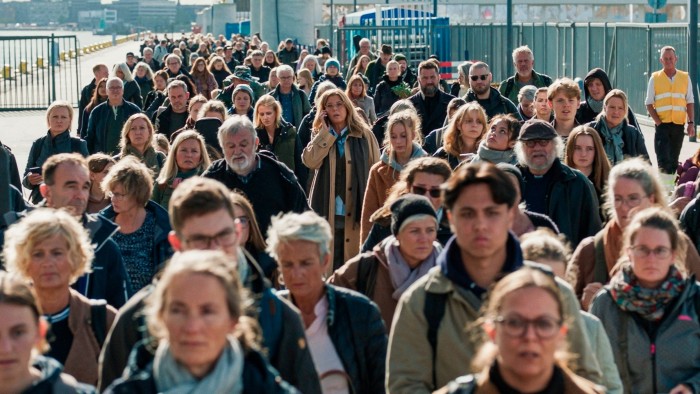
Summarize this content to 2000 words in 6 paragraphs in Arabic Unlock the Editor’s Digest for freeRoula Khalaf, Editor of the FT, selects her favourite stories in this weekly newsletter.“They’re closing down the country.” The words are at once clear and inconceivable. Within a year, Denmark will no longer exist. Brought to the brink of ruin by rising sea levels, the nation’s land area is to be evacuated and abandoned, its people left at the mercy of other states.This is the premise of Families Like Ours, an ambitious and provocative piece of speculative fiction that arrives on the BBC having already caused a stir in Denmark. Created and directed by filmmaker Thomas Vinterberg, the seven-part series imagines a catastrophic climate-crisis scenario for one of the world’s most stable and affluent societies. Though white and in many cases wealthy, its citizens are now regarded by their fellow Europeans as a burden; their neighbours are quick to close their borders and restrict movement rights.While this may sound wildly dystopian, the drama is firmly rooted in a sober sense of realism that makes the hypothetical seem all-too plausible. The country does not suddenly or violently collapse but is dismantled through bureaucracy that dictates where people are moved to and when. We hear rumblings of protest, but mainly see quests for permits and queues for ferries transporting the population to refugee shelters across Europe. The fear of what’s to come competes with the sorrow for what has been lost — from personal comforts to the national culture.Conducted under a gentle Scandinavian sun rather than an apocalyptic deluge, the evacuations seem alarmist, but of course they are the result of an emergency too long overlooked. Ecological warnings serve as a backdrop to the character-led drama of a middle-class Copenhagen family negotiating the emotional and logistical hardships of being uprooted.At the centre is 19-year-old Laura (Amaryllis August), who is not only caught between adolescence and adulthood, but between the people she loves. While her stolid architect father Jacob (Nikolaj Lie Kaas) has secured a visa in Paris, her mother Fanny (Paprika Steen), an ailing ex-journalist, is only offered asylum in a Romanian tenement. Complicating matters further is Laura’s blossoming relationship with classmate Elias (Albert Rudbeck Lindhardt). Faced with impossible choices about whom to follow, she makes rash decisions that lead her into the hands of people preying on desperate migrants.After an absorbing, elegiac start, the series grows bleaker as the family is split across Europe and struggles to find security or compassion. The overarching narrative is thought-provoking and affecting but individual subplots don’t always convince. The romance element is laboured and too much of the series is shaped by improbably heedless impulses.Vinterberg’s decision to focus on one family means we get a narrow vantage point of what is set up as a national — even global — disaster. But as the title suggests, the aim is to cut through to people who identify with the characters but feel distanced from the ordeals of actual migrants. Here we are powerfully confronted with how precarious privilege is, and how quickly we can slip from leafy suburb to smuggler’s ship.★★★★☆BBC4 and iPlayer from May 3 at 9pm