


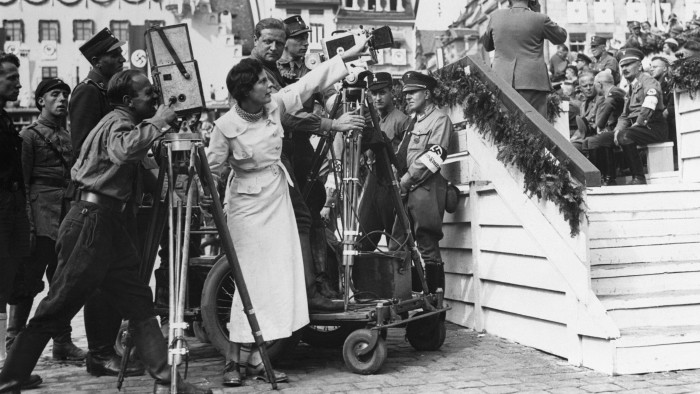
Summarize this content to 2000 words in 6 paragraphs in Arabic The German director and photographer Leni Riefenstahl died in 2003, aged 101, leaving behind a notoriety unparalleled among filmmakers, and questions that are still debated today. Was she a committed follower of Hitler, or a visionary but naive artist whose commitment to beauty and formal perfection came to crystallise the Nazi aesthetic — notably in her documentary about the 1934 Nazi Party Congress Triumph of the Will? Was she indeed a great director and — as British critic David Thomson once suggested — “arguably the most talented woman ever to make a film”?These questions are addressed afresh in Riefenstahl, a new documentary by German director Andres Veiel, who has said that his mission in revisiting the subject was “to show that it is not just a finished life story, but a warning for the future”.The new dimension that Veiel’s film brings to its topic is access to the mass of material — footage, photographs, writing, recordings — that formed part of Leni Riefenstahl’s estate. Riefenstahl’s producer Sandra Maischberger had, as a television journalist, interviewed the filmmaker on her 100th birthday and come away frustrated. “I left with no answers to my questions. I eventually learned that her husband had died [in 2016], and there was this house full of everything, which had to be packed in 700 boxes. I thought: maybe there are the answers.”One thing that emerges from the documentary is that the term “triumph of the will” could well be applied to Riefenstahl herself, her career an implacable process of self-invention. Born in Berlin in 1902, she made her name as a dancer, before deciding that she wanted to appear in the then-flourishing Bergfilm genre of mountain dramas. With no acting experience, she talked director Arnold Fanck into giving her the lead role in The Holy Mountain (1926). It was in the same spirit that, later, she would directly approach an admiring Hitler whenever she needed his support.Riefenstahl learnt mountain climbing from scratch, and became a popular star in Fanck’s epics, shot in brutally challenging conditions. She picked up the essentials of filmmaking and directed herself in The Blue Light (1932), a mystical mountain epic that impressed Hitler. That led to her being commissioned to make documentaries about three Nazi Party rallies, the most notorious and grandiose being Triumph of the Will (1935). Viewed in its entirety, the film is gruellingly repetitive, but its most imposing, chilling moments encapsulate the excess of Third Reich spectacle, and are undeniably impressive in their formal invention. One clip in Riefenstahl shows the director in 1993, rerunning shots from Triumph, clearly enraptured with her own directorial brilliance.Olympia (1938), about the 1936 Berlin Summer Olympics, enjoyed an extravagant budget that allowed Riefenstahl to employ an army of cameramen and develop innovative techniques. It contains legendarily dynamic sequences, both in the factual content — flouting Nazi racial doctrine, Riefenstahl highlighted the achievements of the great Black American athlete Jesse Owens — and in its more fanciful moments. Among them are the intensely eroticised opening evocation of ancient Greece, and the delirious montages of springboard divers seemingly transcending the laws of gravity.Veiel’s film re-examines troubling incidents in Riefenstahl’s career. During her brief stint as a war reporter in Poland in 1939, she reportedly witnessed the execution of 22 Jews — which she may have indirectly caused by demanding they be moved out of frame, resulting in their shooting. She also used Roma and Sinti extras, including children, while directing her fiction film Lowlands — prisoners from internment camps, most of whom would be killed in Auschwitz (Riefenstahl later insisted that they were all alive and well).I would call her one of the first Instagram girls. She was always filming herself, concentrating on being the one person in the middle of the whole universeAfter the war, she would depict herself as a victim, seemingly aggrieved above all that it had ended her career. She would never direct again, despite being officially absolved by German postwar “political cleansing” tribunals of being a Nazi (she was never actually a member of the National Socialist Party).She also repeatedly insisted on her innocence; Riefenstahl shows her responding to difficult questions with outraged petulance. She claimed to know nothing about the Nazi concentration camps until after the war, and even suggested that Triumph of the Will, for all its fulminating speeches by Hitler, Rudolf Hess and others, was only about “work and peace”.In a 1976 German TV programme, we see Riefenstahl resist the suggestion that she could have refused to work for the Nazis. “Back then, the whole world was enthralled by Hitler,” she protests. She certainly was; in one interview, she states that when she first saw him speaking at a Berlin rally, “my whole body was trembling . . . I was somehow captured, as if by a magnetic force”.But the predominant magnetic force in Riefenstahl’s life seems to have been her own personality: she emerges as strikingly narcissistic, concerned above all with her career and reputation. Upset that Olympia’s release was postponed because of Germany’s annexation of Austria, she talked to Hitler and succeeded in getting it premiered on his birthday.Despite all this, Riefenstahl reminds us that in the 1970s she re-emerged as not just an acceptable but a fashionable figure — partly as a result of her photography documenting extended stays among the Nuba tribes of Sudan. Her new credibility, wrote Susan Sontag in her 1975 article “Fascinating Fascism”, was part of that decade’s vogue for seeing Nazi aesthetics as essentially Pop Art. In 1974, Riefenstahl was commissioned by the Sunday Times to photograph Mick and Bianca Jagger and was a guest alongside Gloria Swanson and Francis Ford Coppola at the Telluride Film Festival; the following year, Andy Warhol spoke to her for his Interview magazine.Claims have been made for the formidably autonomous Riefenstahl as a feminist pioneer. “Here was a woman who made her career, she created herself,” says Maischberger. “That was something which I would love to have admired as a woman. But looking at her deeply, there was nothing left to admire. Her lack of empathy doesn’t really make her a role model.”She points to Riefenstahl’s fixation with her own image. The director had herself filmed a great deal, notably by her husband, cinematographer Horst Kettner; we see her in her later years at home and skiing, as well as cutting a disturbingly imperious figure among the Nuba. “I would call her one of the first Instagram girls,” Maischberger observes. “She was always filming herself, concentrating on being the one person in the middle of the whole universe.”Riefenstahl’s images have left an enduring legacy — both in real-world demonstrations of sporting prowess and political power, and in their on-screen representations, not least in science fiction. “While we were editing,” says Maischberger, “people were calling us and asking, ‘Have you seen Dune: Part Two? It looks like Triumph of the Will, the way the masses of soldiers are arranged.’”For critics like Sontag, Riefenstahl’s preoccupation with beauty and physical strength were consistent with a fascistic ideology traceable right through to her photos of Nuba wrestlers, and as far back as her mountain films, which for Sontag are already about “the vertigo before power”.All this may be theoretical, but Riefenstahl proposes more concrete indications of its subject’s beliefs. After she was quizzed on that 1976 TV programme, many German viewers contacted Riefenstahl to express their support and outrage at her “mistreatment”. Her most telling exchange with an elderly fan is left for the very end of the film; it seems that for all her denials, Riefenstahl talked the Nazi talk, at least in private. But, above all, she created the pictures; even today, those pictures and their meanings remain intensely, distressingly indelible.‘Riefenstahl’ is in UK cinemas from May 9Find out about our latest stories first — follow FT Weekend on Instagram and X, and sign up to receive the FT Weekend newsletter every Saturday morning