




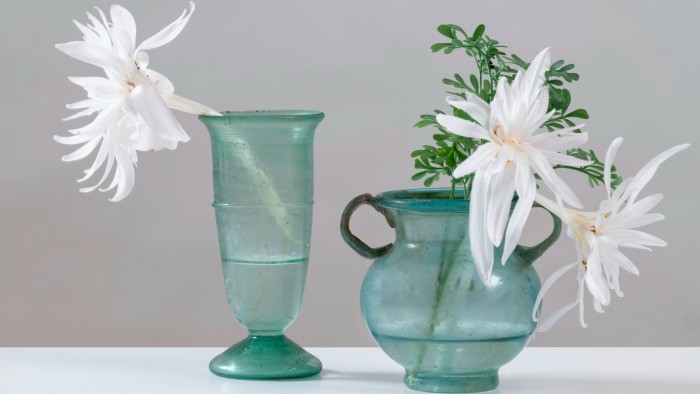
Summarize this content to 2000 words in 6 paragraphs in Arabic Stay informed with free updatesSimply sign up to the House & Home myFT Digest — delivered directly to your inbox.A klutz like me really should not be allowed to hold this. Yet here I am in a book-lined office at art dealers Charles Ede in London, with a Roman glass flask in my hand. The flask, a small bruised-purple sphere rising to a thin neck, one handle in green glass, the other in blue, weighs almost nothing. Its glass is thinner than a lightbulb. I do not trust myself.“It’s like the first time you hold a baby,” says Charis Tyndall, a director at the gallery. “You’re terrified and then you realise, actually, just hold it in the right way and it’ll be all right.”Tyndall has handled plenty of Roman glass: Charles Ede is holding an exhibition of more than 100 pieces, which Tyndall has been acquiring over several years, from May 29. Some of the vessels will be filled with flower arrangements by Shane Connolly, demonstrating that they are both intact and useful.Connolly is trying to evoke a sense of continuity with his floral choices. “Romans really prized wild strawberries,” he says. “I brought some from my garden [for the photo shoot]. And just the fact that those vessels would have seen those wild strawberries, 2,000 years ago, that’s what I found the most interesting.”People have been making glass since the bronze age, but the technique of glassblowing was developed by Syrian craftspeople in the first century BC in the Levant. It produced glass of such lightness that we still have not figured out how to replicate it exactly, says Sidney Goldstein, former curator of ancient glass at the Corning Museum of Glass in upstate New York.The newfound ease of glassblowing meant that vessels and objects, perhaps as many as 100mn annually, were produced across the Roman empire for every possible use: drinking, storing perfumes and oils, shipping foodstuffs, as jewellery, mosaics, mirrors, windows. They came in every shade too, depending on which metallic oxides were added; colourless glass quickly became the most valuable, because the need to remove all the impurities meant it was the most complicated to make. Their fragility means only a tiny proportion has survived, often in tombs.It’s like the first time you hold a baby. You’re terrified, then you realise, just hold it in the right way and it’ll be fineTheirs is, Charles Ede says, the first dedicated commercial exhibition of Roman glass for more than 40 years. While it has a passionate collector base, it is small, its members older and it carries an (unfair) hint of scholasticism, of a niche within a niche. Consequently it is relatively inexpensive compared with other artefacts from the era: the price range at Charles Ede is £500-£25,000.Some recent sales at auction house Bonhams were in the low hundreds of pounds, says Joanna van der Lande, its senior consultant for antiquities in London. She has run sales of large collections of Roman glass and is heartened to find new bidders, some attracted by the objects’ antiquity, others by their modernity — the simplicity of their designs can sit alongside contemporary art.The world record for Roman glass, van der Lande believes, is the Constable-Maxwell cage cup, where the ornate filigree structure that supports the bowl is carved from the same piece of glass; it sold for £2.65mn at Bonhams in 2004. Buyers do need to exercise care, of course. Aside from fakes (the heaviness is usually a tell), there is a pall of suspicion around ancient artefacts that might have been illegally taken out of the ground, their sale funding terror networks. From June, a new EU regulation demanding proof of legal export for archaeological artefacts more than 250 years old will address this. Anyone looking to buy should make sure they purchase from reputable dealers; that online-auction bargain may be more trouble than it’s worth.But for some, once you’ve started buying ancient glass, it can be hard to stop. Nico Bijnsdorp, one of the world’s great collectors, began in 1995 after he saw a piece at the Tefaf art fair in Maastricht — and ended up with 420, from the seventh century BC to the seventh century AD, paying from £100 to £100,000. It was “an addiction”, he says. He sold off three-quarters of his collection in 2022-23 when he and his wife downsized.Unlike me, Bijnsdorp has no fear of holding his glass. “I do not wear gloves, I just take it in my bare hands,” he says. I’m going to take heart from this: if Roman glass has survived 2,000 years, it can survive me.“Roman Glass” runs at Charles Ede, London, May 29-June 6, charlesede.comFind out about our latest stories first — follow @ft_houseandhome on Instagram