




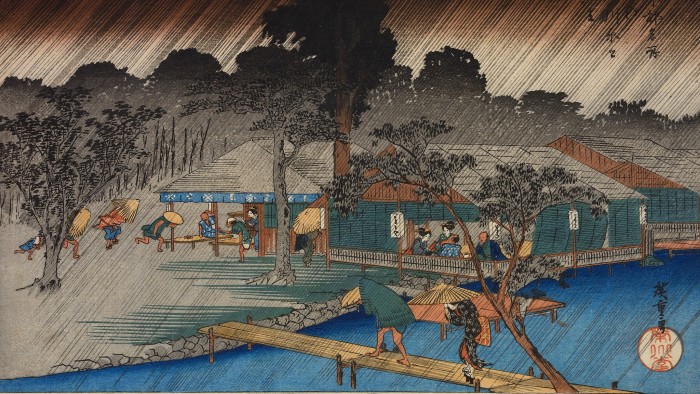
Summarize this content to 2000 words in 6 paragraphs in Arabic In Utagawa Hiroshige’s “Shōno — Sudden Rain Shower” (c1833-35), porters carrying a palanquin race for shelter. Their bodies bend as a storm cloaks the sky in a half-lit grey. The bamboo trees loom like giant waves. The water that lashes Kyoto’s theatre district in “Sudden Shower over Tadasugawara” (c1834) is even angrier: black lines strike percussively across the picture, obliterating sunlight. One of the last great masters of the Japanese ukiyo-e woodblock print, among Hiroshige’s many achievements are these portrayals of rain.I look at “Sudden Shower over Ōhashi and Atake” (1857) for a good while. Here, Hiroshige’s rain creates fine threads running down the print — though the smudged black of storm clouds closing in at the top of the picture suggests even more to come. Three men clutch a single umbrella, caught unawares by the summer shower. It’s one of many moments of piercing atmosphere in the British Museum’s magisterial survey Hiroshige: Artist of the Open Road, much of it drawn from the collection of American businessman and connoisseur Alan Medaugh.There is nothing particularly special about a rain-washed landscape. So why is the eye so irresistibly drawn towards these? You can explain it away in formal terms: how Hiroshige bisects his picture in dramatic diagonals of, say, bridge, water and shore.Or perhaps these pictures acquire their sense of movement from the printing itself. A carved cherry wood block is inked with vegetal or chemical pigments: the pink of safflower petals, the yellow of arsenic sulphide, the white of ground seashells, or Prussian blue. Mulberry paper is pressed on top, the printer rubbing it in circular motions with a pad of bamboo bark. The process is repeated with different colours, like pieces of a puzzle.The true answer, I think, is harder to express. Hiroshige is a sharp observer of fleeting moments — of the ways, for instance, travellers scatter when a storm breaks. His art is about how a whole landscape can change in that split second: tempo, texture, mood. He was born in Edo, now Tokyo, in 1797 to a low-ranking samurai family, the son of a fire warden. His childhood was stalked by death — his elder sister died when he was three, his mother when he was 12, and his father a year later. He was apprenticed to an artist of the prominent Utagawa school — known for pictures of beautiful women — soon after.Hiroshige lived through an era of vertiginous change. He came to fame in a time of crop failure, disastrous famine, economic crisis and tensions within the samurai elite. When he died a debtor at the age of 62, during a cholera epidemic, Japan had been “opened up” by American gunboats. But you wouldn’t know any of this from Hiroshige’s self-contained ukiyo-e, woodblock prints of Edo’s “floating world”.Such prints, which sold for little more than bowl of noodles, bristle with the city’s revellers, courtesans and kabuki actors striking a pose. They must have felt so tangible, familiar. Small wonder that many were also printed on bamboo fans (of which Hiroshige designed 600). Has pop culture ever looked so good?Still, in his early pictures, it is the natural world that holds the eye and stays in the mind for hours afterwards: moonlight, frosted trees and scudding clouds. In one, three statuesque beauties twist and turn in richly decorated outfits, but what actually sets the print in motion is the starry night behind them. In another, a woman walking in thick snow stabs her umbrella in the ground to test for a sure footing. It’s a vivid detail.His depictions of animals are lovely too, whether a mean-looking cuckoo descending at speed, or a white rabbit’s red eyes gazing up at the full moon. Spookier is his picture of the rice god Inari’s spirit foxes, their breath turning to flame in the icy night air.I adore the raftsmen slowly making their way to Kyoto in “Arashiyama in Full Bloom” (c1834). One rests on the tiller; the other is lost in wonder at cherry blossom petals fluttering in the breeze. The speed at which they cut through the water is suggested by sinuous wake lines, the river’s blue turning to burnished white under sunlight.Bokashi is a shading technique accomplished by softening the ink with water, to control light and colour. You see it everywhere in Hiroshige’s work, from black mountains wreathed in cloud to the developing pink of the early dawn sky. It hangs over a patron bidding farewell to a courtesan in “Morning Cherry Blossoms in the New Yoshiwara” (c1831).It wasn’t pictures of Edo’s pleasure district that made Hiroshige’s name, though. Instead, it was life on the road. In 1832, at the age of 35, the artist accompanied a delegation bearing gifts of horses from the shogun in Edo to the emperor in Kyoto. He travelled the ancient 500km Tōkaidō, a popular coastal highway dotted with tea-houses and inns.The scenes he saw flowed into The Fifty-three Stations of the Tōkaidō. The series was such a hit that the original printing blocks were swiftly worn out. In Japan, everyone wanted these pictures.You can see why. In “Nihonbashi — Morning Scene” (c1833-35) the entourage of a samurai lord scurries ahead carrying luggage and feathery banners, their faces bowed and dutiful. At another stop on the road, the landscape is almost completely drained of colour, the snow turning it into a study in black and white. If you were a tourist travelling that road, such prints were the perfect souvenir. For the armchair traveller, they served as portals to other places.The artist once said of his work that they were “views that I had before my very eyes and took down exactly as I saw them”. But this doesn’t feel true of Hiroshige’s stranger moments. Take the perspective of his late series 100 Famous Views of Edo, in which one motif dominates the foreground to distorting effect.In “Suidō Bridge and Surugadai” (1857) a monstrous black carp has flung itself into the sky. But wait — that fish isn’t actually flying. It’s a festive kite, coiled in the wind. Van Gogh, an avid collector of Hiroshige, so admired the effect of close-cropped branches in “The Plum Garden at Kameido” (1857) that he recreated it in oils — the exhibition includes his careful tracings on grid-lined paper.Hiroshige completed a series of pictures around another route connecting Edo and Kyoto. The Kisokaidō was an inland path that threaded through what are known today as the Japanese Alps. You just need one look at Hiroshige’s triptych “Mountains and Streams of the Kiso Road” (1857), its travellers dwarfed by gorges, waterfalls and sheer expanse of rock, to realise this was a very different road to the Tōkaidō. And yet even here, on the treacherous Kisokaidō, Hiroshige found the fleeting moment once again. “Karuizawa” (late 1830s) is an astonishing picture in an astonishing show, proving Hiroshige’s utter mastery of darkness and light. In the middle of the night, a weary trader has arrived late at a post station. His servant stops to light his pipe by a bonfire. The flames rise higher, puffing out a glowing plume of smoke that briefly lifts the darkness — the emerald leaves of a nearby tree revealed. It is a kind of magic.To September 7, britishmuseum.orgFind out about our latest stories first — follow FT Weekend on Instagram and X, and sign up to receive the FT Weekend newsletter every Saturday morning