




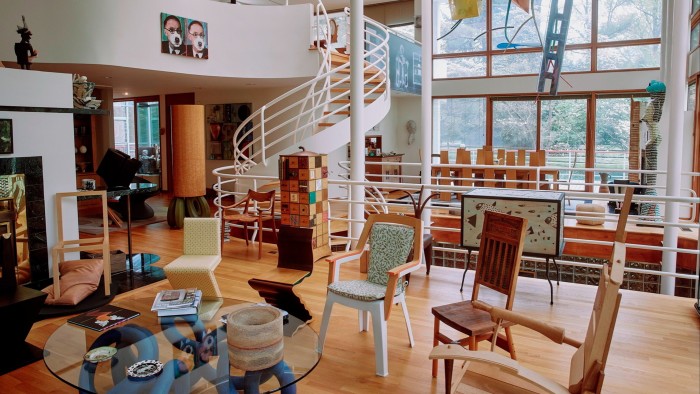
Summarize this content to 2000 words in 6 paragraphs in Arabic When the sun shines through the glass gable of Diane and Marc Grainer’s home in Potomac, Maryland, its contents seem to come alive. Sculptural chairs throw strange shadows that dance across the living room floor and a giant ceramic totem of writhing figures glistens in the light. It’s as if the objects might start to talk.“You can never feel lonely here,” says Diane of the 1980s house designed by the late architect Elias Charuhas, encircled by tall trees. “Not even during the pandemic. We were lucky to be surrounded by so many friends, as I think of the pieces.”Over several decades the Grainers have filled their home with ceramics and furniture by mostly British artists, including Alison Britton, Gordon Baldwin and John Makepeace. It feels like a museum, with vast, white, double-height rooms and numerous works displayed in custom-made cabinets and on plinths, shelves, tables, walls, floors and ceilings — and beside bathroom sinks. Even the couple’s bed and nightstands were a special commission by Canadian designer Peter Pierobon. “I joke to him that we get to sleep with him every night,” says Marc.It’s a testament to the scale of the collection that the home feels so full, despite more than 350 artworks having recently been removed as the couple anticipate downsizing. The only clues that anything is missing, if you look hard enough, are a few nails protruding from walls and the odd empty plinth. A cache of artworks will be on display at ceramics auction house Maak during London Craft Week this month (May 10-15), before a two-part sale. More still have been donated to museums. “It’s been a huge wrench to say goodbye to the works,” Diane adds, “but we’re happy that other people will get to enjoy their company.”Many of the larger pieces, suited only to a home of this size, had to go, but the couple have kept their favourites from each artist. Filling the house’s sculptural curves, sharp corners and glazed living spaces, the works — such as Richard Slee’s faceless black cat that stares out of a window, warding off unwanted guests — exude a wry humour. Much like their owners.Despite being “institution builders”, as curator and author Glenn Adamson has called them, neither Diane nor Marc has a background in the arts. Diane was an English teacher and Marc co-founded customer services business Tarp before retiring in 2021. But after becoming renowned for the collection they built in their spare time, they both took on board roles at major institutions: Diane was president of the James Renwick Alliance (which supports the Smithsonian’s Renwick Gallery) and Marc was the non-executive chair of the American Craft Council.It was while on business trips to the UK that Marc began collecting, beginning with a richly textured stoneware jug by Robert Fournier from a now closed Oxford gallery in 1978. “Instead of taking suitcases, he took boxes filled with bubble wrap and came back with maybe 25 pieces at a time,” says Diane, who is dressed in a riot of pattern when we meet, like her husband (the pair sometimes match their outfits). She soon matched his enthusiasm. At the time, ceramics weren’t the high-value art medium they are today, Marc says, and work by the best UK artists was a third of the price of “a second-rate” piece by an American artist. He says free tuition in Britain at the time, compared with exorbitant university fees in the US, gave artists more liberty to take risks. Alison Britton, Carol McNicoll and Jacqueline Poncelet, for example, were experimenting with the medium, rejecting the orthodoxies of traditional British studio potters such as Bernard Leach. “I view Alison as an abstract expressionist,” he says, pointing to two asymmetrical, slab-built forms mounted on plinths on the ground floor, with gestural marks of slip on their surfaces. “She uses the pot as a canvas and a sculpture.” An irreverent streak is seen throughout the collection, thanks to artists such as Carol McNicoll. When Marc asked McNicoll to make a chandelier for above his desk on the gallery overlooking the dining area, she hung six slip-cast figures from a metal aperture alongside found glass objects — without a single light source. An acquired taste, perhaps? “It’s a dark piece,” agrees Marc, “but it made me happy because Carol was a hoot.” Diane prefers objects with an upbeat sentiment. “I like work that makes me feel comfortable and warm,” she says, pointing to a bulbous pot by the late Waistel Cooper, with a rough, textured surface.It was their collecting that brought them to this house. In the 1980s, Diane would join Marc in London on summer holidays with their two boys, driving to Cornwall for trips to the beach and potters’ studios. “The boys had to share the back seat with ceramics,” she says. They soon began buying furniture too, such as the 1998 Phoenix II chair by John Makepeace, included in the Maak sale, crafted from ancient bog oak and burr elm. The couple acquired pieces with such gusto that by the 1990s they had overtaken their previous home in Falls Church, Virginia. “We had ceramics on the couch and the dining table,” says Diane. “Marc woke me early one morning in 1998 saying, ‘I’ve just seen my dream home on a local real estate TV programme.’ We called the realtor that day.” Charuhas — best known for designing subways and embassies — built the home for his family but died shortly afterwards. It won a 1986 American Institute of Architecture award for “distinctive residential architecture”. “We call it the faux Richard Meier house,” says Marc, pointing to how Charuhas borrowed curves and geometric forms typical of Meier’s buildings, splicing them with postmodern flourishes like the glass gable framed in red metal. “We went to the Getty Museum [designed by Meier] in Los Angeles soon after moving here and I kept seeing bits of our house there,” says Diane.Its curved gallery level and flowing spiral staircase has made it the perfect receptacle for art. Even the sauna and laundry room have been filled. “It’s ironic that the house’s original owners had a minimal aesthetic,” says Diane. The high ceilings meant they could acquire works such as the 14ft-tall totem at the bottom of the staircase: a lushly glazed mass of heads and limbs made by Korea-born Sunkoo Yuh in 1999 that references his diasporic existence. The piece — which will soon be in the Everson Museum of Art, Syracuse — has a strange, ugly beauty. “Ceramics have become too boring and tasteful today,” Marc says. “In recent decades, people have been losing the ability to make things by hand, so supporting consummate makers feels important.” Five per cent of the auction proceeds will go to the British Crafts Council, which supports the UK craft scene.“Every time we look at a piece we see something different,” says Marc, as Diane spins a metal and wood sculpture by American artist Tommy Simpson on a lazy susan, mounted on a table. “You can revisit a piece in a gallery or museum, of course, but nothing beats being able to enjoy it as you kick off your shoes and relax in a comfortable chair.” “A Life in Craft: The Grainer Collection”, May 10-15; maaklondon.comFind out about our latest stories first — follow @ft_houseandhome on Instagram