



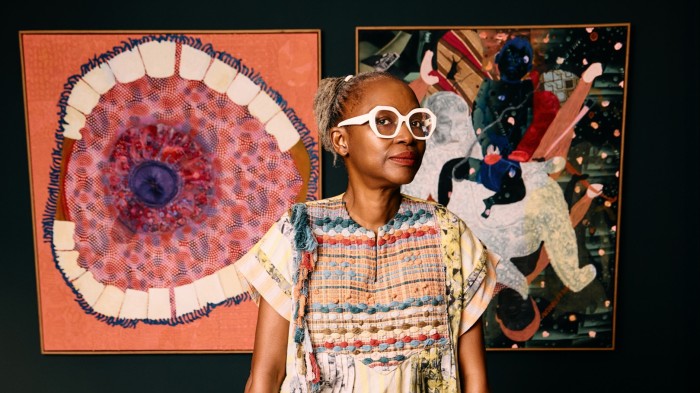
Summarize this content to 2000 words in 6 paragraphs in Arabic My personal style signifier is understated elegance. I’m interested in sartorial philosophy and knowledge as well as colour, sculpture and material. The nobility of material is especially important to me – I don’t wear viscose, nylon or anything like that. Design should be visually and aesthetically generative, with a connection to where the item was made. Clothes should say something. The last thing I bought and loved was a pair of jeans from my dear brother, Lamine Badian Kouyaté, founder of the Xuly Bët label, who is one of my fashion gods. I call him a kamikaze of fashion because he’s in it without being in it. He’s Malian-Senegalese, lives and works in Paris and went into fashion after training as an architect. He makes clothing that fits Black women’s bodies in a space that’s somewhere between streetwear and high-end fashion. This pair of jeans is, like, the fifth iteration of a style he’s been doing for more than 20 years. They are very baggy and dark, hip-hop style, and when you roll them up, you can see Xuly Bët’s logo in red. They’re so flamboyant.The place that means a lot to me is Dakar, Senegal – my everything. It’s the place I came of age professionally, where I really became a curator and an exhibition-maker. Dakar made me who I am today. There’s a natural elegance to Senegalese culture and people. Of course, there’s a material sartorial element, but I’m talking about the elegance of spirit and mind. Senegal has this extremely welcoming, pacifist ancestral culture. I’m in Cape Town now but, mentally, I live in Dakar. It’s the one and only place for me.I never buy souvenirs. It’s cheesy, it’s tacky, it’s stupid. What I bring home is my experience with people, which is emotional, intellectual and spiritual. The best book I’ve read in the past year is a book on African philosophies, The Ink of the Scholars: Reflections on Philosophy in Africa, by Souleymane Bachir Diagne, one of our most brilliant thinkers. He challenges the idea that there isn’t a philosophical framework to African societies. There are ideas around Africans being the great architects of hospitality and Diagne reflects on what the African approach to humanity is. What does it mean to be careful, mindful and caring? It’s not just about welcoming people to your home or feeding them. Hospitality is carrying people, making people feel comfortable in your environment – it’s intellectual and emotional. Everyone should read Diagne, full stop.I don’t listen to podcasts – I prefer radio, which is less constructed. Nobody ever knows themselves, really. You’re never what you think you areMy style icons are my mum and grandma. My grandma has passed and my mum is ageing, so she doesn’t spend that much time on style any more, but I learned elegance from them. Women of that generation would make clothes for themselves and their children. My grandma was very, very traditional. What I liked about their style was that everything was effortless, which a lot of people tell me about my own style. I don’t really pay attention to what I wear most of the time. I wake up in the morning, I’m in a certain mood and I pick something. Nothing is planned. It’s like cooking – pantry cooking! The best gift I give is chocolate, usually Cameroonian or Swiss. I also gift a lot of clothing. The best plan is to hang around with me while I’m away. I never really go shopping, but sometimes when I have a moment between meetings and I’m in a place where some of my favourite designers are, I’ll find a moment to visit somewhere. Whoever is with me will always get something too.And the best gift I’ve received is the faithfulness and love of my friends – artists Otobong Nkanga and Julie Mehretu, among others. Their support and belief in my work and vision . . . that’s the best gift I can have.My favourite building is Immeuble des Eaux in Dakar. I love traditional African architecture, but this building has a mystery behind its origins. For the longest time it was said to have been built by Le Corbusier, but that has never actually been proven. And I love where it’s located. When you come downtown, it’s the first building you see.The last music I downloaded was Massive Attack’s debut album, Blue Lines. I’ve been listening to it on a loop for the past three weeks and I don’t know why. I haven’t listened to it in years, but I’m completely back to that Bristol Massive Attack moment.I have a collection of shoes, but you can’t call it a collection. I’d call it an obsession. They include Studio Wudé, Marni, Prada, Nike and Stefi Talman.The best way to spend £20 – about 500 South African rand – is on two whisky sours at Between Us in Cape Town.I’ve recently discovered I have a problem with the concept of discovery – the term is misleading. When we say we’ve discovered something, what we mean is that it’s the first time we have personally been exposed to it. But you are not the first person to interact with that thing. There are a lot of curators and creatives who say, “I discovered this, I discovered that.” It’s super-pretentious to think you discovered anything in the 21st century.In my fridge you’ll always find ginger juice, butter, chilli paste and champagne – I like Ruinart or Le Lude, a natural sparkling wine. Next to water, champagne is the only thing you can drink at any time of the day, from breakfast to dinner.I couldn’t do without my glasses. I wear a pair by Fielmann.An indulgence I would never forgo is great food! All the great African dishes – I love them to death. And, of course, Japanese food. Delicious food doesn’t need to be super-elaborate; I love comfort food like Jamaican callaloo or a good Brazilian feijoada. I joke that you can always corrupt me with food, particularly okra soup. I have a group of friends and we call each other “okrapolitans”; I’m the high priestess of the okra church.My beauty guru is Hattie Makelele, who plaits my cornrows and has been doing my hair in Cape Town since 2019. I like super-traditional braiding. I’m interested in everyday people who are good at their craft.I do believe in life after death because I come from an ancestral Black education where we believe in parallel lives and realities. There is no “after death”, “before death” or “during life”. It doesn’t matter that much. I believe in energies – living or dead – and in cosmic strength. The beauty staple I’m never without is pure shea butter that we buy at the market for $2. It’s the best, particularly for Black skin. My favourite room in my house is my bedroom, which is both a refuge and a place to work. I work a lot from bed. I wake up quite early – around five, five-thirty – and it’s between then and eight that my best ideas come together. I gather my thoughts, take notes and write emails. By the time I get up I’ve already worked for two or three hours.The artist who changed everything for me was Senegalese conceptual artist Issa Samb. I always understood art as an objective, a commodified materiality. With Issa, I got into this sphere of understanding art as a philosophy of life, as a thing that can be intangible. That led me to my current position where I see it as an extension of life. On my Instagram “For You” page you’ll find a lot of art and design. I read very critical magazines – The Atlantic, The Brooklyn Rail, Africa Is a Country, Le Monde Diplomatique – so those all come up. And also braiding styles such as cornrow. In another life, I would have been a midwife. I nearly trained at one point, but then I went into art. I think of curating as another form of midwifery, in so far as you enable works to be born.My favourite app is maybe Google Maps. It changed my life. Mostly I’m an IT idiot; an analogue survivor in the digital world.When I need to feel inspired, I go to sleep. For ages, I felt that sleep was a waste of time. I would brag, “Oh, I don’t need more than three or four hours.” Then I became smarter and understood that accumulation of fatigue has incredible repercussions on your life, on your body, on many things.The best bit of advice I ever received was to be conscious of the blind spots. Nobody ever knows themselves, really. You’re never what you think you are. Since I became the executive director and chief curator of Zeitz Museum of Contemporary Art Africa, where I lead 70-plus people, I’ve had to depend on the mirror of others to see myself fully. By growing your self-awareness and becoming more conscious of the fact there are things you can’t see, you become more alert to the things within yourself and the people around you.