



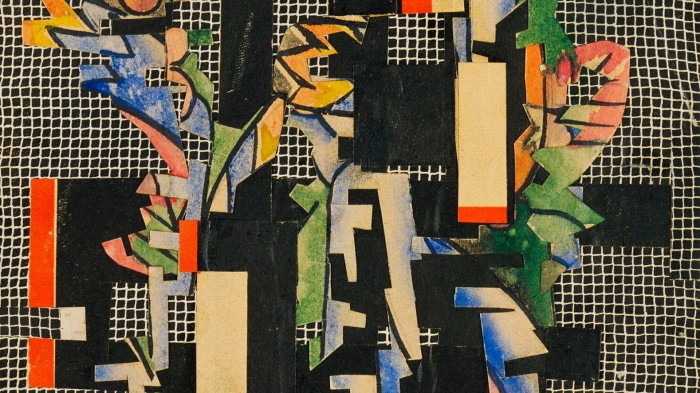
Summarize this content to 2000 words in 6 paragraphs in Arabic Unlock the Editor’s Digest for freeRoula Khalaf, Editor of the FT, selects her favourite stories in this weekly newsletter.If Woven Histories: Textiles and Modern Abstraction had bowed out after the first of its eight galleries, it would have been fabulous — a miniature Jazz Age blockbuster about the days when art and craft together were supposed to usher in a new society.Two of Anni Albers’ tablecloth designs, done in watercolour and gouache, quiver with static energy. Hannah Höch’s “Collage II (On Filet Ground)” (1925) suggests a head-on collision between Mondrian and Matisse, shards of orthogonal and sinuous forms promiscuously thrown together. Sophie Taeuber-Arp’s “Vertical, Horizontal, Square, Rectangular” (1917) demonstrates how to make such simple geometries dance. And Paul Klee’s “Fire in the Evening” (1929) reinvents the sunset scene as a cascade of ruled horizon lines with a vermilion square of sun near (but not quite at) the centre of the frame. You could whip around this one room, inhale the ozone smell of possibility between the wars, and leave fortified and even exhilarated.Or you could proceed and be disappointed. The galleries that follow overflow with fibrous oddments: rectangles of tapestry in white, off-white and speckled white; baskets, nests, husks; holey dresses by Rosemarie Trockel and Andrea Zittel; snarls of yarn, fringes and checkerboard knits. All that technical variety and the show’s 100-year span resolve into a collection that’s somehow both inchoate and homogeneous.Boundaries have been breached, hegemonies shattered, taxonomies reorganised! The curator presents this bolt of enlightenment as if it had descended only yesterday, rather than a couple of generations agoMoMA has bulked up the already shaggy show that appeared at the National Gallery of Art in Washington, Los Angeles County Museum of Art and the National Gallery of Canada, and the result is threadbare. Text panels try to resuscitate faded academic debates, swaddling a thin premise in layers of tattered jargon. (I’ll spare you that last bit, at least.)Once upon a time, we’re told, art and craft were rigorously separate disciplines, practised by different kinds of people and confined to their places in the hierarchy of visual media. Painting and sculpture, secure in their impracticality and in the pre-eminence of men, enjoyed the most rarefied prestige. Objects that could theoretically be used, especially if made of clay, fabric or glass, belonged to a lesser class of creativity, where women toiled over looms or clicked their needles to pass the time.But, lo, those boundaries have finally been breached, hegemonies shattered, taxonomies reorganised! Curator Lynne Cooke presents this bolt of enlightenment as if it had descended only yesterday, rather than a couple of generations ago. The distinctions between high and low, artist and artisan, insider and outsider feel like topics in a scholarly conference of 40 years ago. When was the last time a snobbish critic sneered at an Albers for being made of thread?The show’s many components are roughly lashed together by the last two words of the subtitle: “modern abstraction”. This is a compressed allusion to a theory articulated by the art historian Rosalind Krauss in 1979: that the essential form of the 20th-century avant-garde was the grid. “By ‘discovering’ the grid, cubism, de Stijl, Mondrian, Malevich . . . landed in a place that was out of reach of everything that went before. Which is to say, they landed in the present, and everything else was declared to be the past.” Cooke extends the argument, pointing out that all that yummy gridness was perfectly suited to textiles, which sprang from the crosshatching of warp and woof. Weaving was primed to be modern, and also abstract.That’s a pretty narrow argument on which to base an exhibition geared to the non-academic public, and so selective as to be misleading. For one thing, non-representational grids and patterns have been part of textile art for centuries. Just a year ago, the Metropolitan Museum of Art presented Weaving Abstraction in Ancient and Modern Art, juxtaposing Albers, Sheila Hicks, Lenore Tawney and Olga de Amaral with 500 years’ worth of works from the pre-Columbian Americas. And MoMA’s emphasis on grids also ignores an awful lot of squishier, squigglier but equally authentic modernists — Kandinsky, say, or the surrealists. The frayed logic leads to a loose organisation, with sections on knots, labour practices and “self-fashioning” (that is, making your own clothes). It starts to seem like what holds the show together, especially when it gets to recent years, is nothing but a set of tenuously associated observations. It’s hard to grasp the relationship between, say, Andrea Zittel’s 2012 gouaches of people with beach towels and window curtains, and the phallic-looking eel trap woven out of spiny sedge grass in 2003 by the Australian Ngarrindjeri artist Yvonne Koolmatrie.A little intellectual bagginess wouldn’t matter so much if the exhibition were more sensually gratifying — if viewers were being gently led through a profusion of creative expressions, free to detect unintended harmonies. But after that first blast of brilliance, the array of soft pieces lacks punch and self-evident distinction. And so with little to engage the eye, we’re left wandering confusedly through a vast tangle of footnotes.To September 13, moma.orgFind out about our latest stories first — follow FT Weekend on Instagram and X, and sign up to receive the FT Weekend newsletter every Saturday morning