



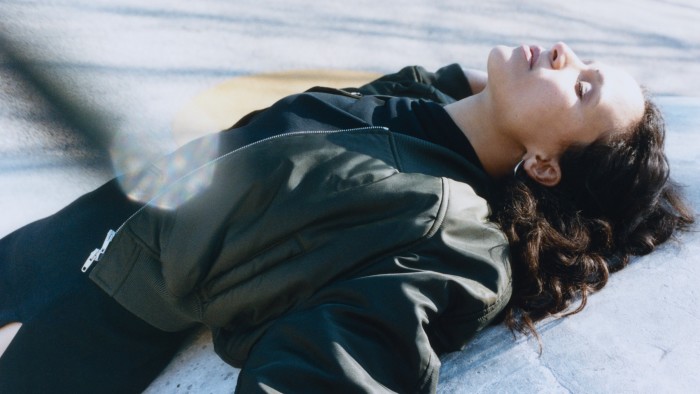
Summarize this content to 2000 words in 6 paragraphs in Arabic Paris-born filmmaker Mati Diop, 42, has created two full-length feature films: 2019’s Senegal-set drama Atlantics, which won the Grand Prix in Cannes that same year, and last year’s documentary Dahomey, which explores the repatriation of looted artworks from Paris to Benin. For this issue, Diop chose to be interviewed by her friend, British musician Dev Hynes. The Essex-raised Hynes, 39, has been a prolific singer-songwriter for 20 years, garnering particular acclaim for his solo albums under the name Blood Orange. They became friends when Hynes asked her to work on a project, which ended up being a collaboration between them and another director, Manon Lutanie – for the short film Naked Blue, Diop and Lutanie co-directed, and Hynes composed an orchestral score. “It felt like a conversation,” is how Diop puts it. Today, they continue that conversation.DEV HYNES: I feel like, with your films, I can see you in them.MATI DIOP: Oh, yeah. That’s absolutely accurate. I mean, I’m in them; they are in me. I think we can say that for a couple of filmmakers, if not necessarily all of them. Like, for example, we’ve been sharing our mutual admiration for Mia Hansen-Løve’s work. Not only because she speaks of herself, but also because there is this special texture that is hers. Like Claire Denis’ unique vibe. I dream my films very deep before I make them and they stay with me. I always say that my music-making is from a place of being a fan – that idea of when you’re younger, and you had posters on your wall. And I still make music from that place. So I’m wondering: were there films or characters or musicians that, when you were younger, were turning points? Were there characters you wanted to be or that inspired you?Kids by Larry Clark, which I discovered at the age of 13, was a shock because I could finally identify with teenagers of my age. Something about them was so much more inspiring than what was happening around me in France. I was growing up in Paris, in a quite boring neighbourhood, the 12th arrondissement. When I saw the film, the characters became the centre of the world to me, it was everything. Their style was beyond cool but it was also about the city, the urban culture and how these kids were taking the space, the streets, through skate, through drugs, through music. As soon as I saw that film, I started to dress exactly like them. It was a shift. My fascination for the New York underground scene began there and the influence kept growing with John Cassavetes, Harmony Korine, Abel Ferrara and the work of Nan Goldin.I get that. I feel like it’s not the same now, maybe just because of the internet, and maybe even the state of America. But I do feel there is something to be said about when we were younger, and that European-American divide. I felt that too. This thing of “Why wasn’t I born there?” Or “What is this world? I want to be inside it!”When you discovered that scene, were you in England? Yeah. I didn’t move to New York until I was 21. You were in Essex… Which I can’t really picture.Umm… Have you seen Fish Tank [the 2009 film by Andrea Arnold set on an east London council estate]? Yes. That social background had come to look quite attractive in the film. But I guess it’s another thing when you are a teenager in the 1990s living in the suburbs – it must feel anything but cool.Yeah. It couldn’t be further away. But, you know, it’s funny. The British have a history of showing the working class on TV and in film. If you think of British film and TV off the top of your head, the things that will probably come to mind will probably be of the working class.Through Ken Loach?Yes, or Mike Leigh. So growing up like that is weird because it’s a bit of both. On one hand, you’re from it, and so you’re a little bit over it and you don’t want it to exist. But then at the same time, it shines a light on it… It shows the beauty in it. But at the same time, you don’t want to be there! But then also what’s strange is that a lot of those filmmakers are not from there. Oh wow, that’s a very important thing to know. It’s a good thing that this is being questioned more today. The debate doesn’t always go in the right direction, but fortunately we are at a time when people are more critical about who is more or less legitimate to tell this or that story.What really led me to make Atlantics is the urge to have African narratives and Black faces being strongly represented in global cinema. It felt like a mission that haunted me for many years. The more distance I have gained from the film, the more I’ve understood that the main idea was to create a film that would make us, African people and Black people in general, fall in love with ourselves again.This extreme attraction I felt towards a certain American white cinema in my early 20s was complex as a Black woman. Falling in love with a world, wanting to belong to a world that does not represent you as a Black [African] woman is tricky and toxic. I was aware of that alienation but still the attraction was too strong. At some point, I felt the need to cut myself off from this hegemonic white culture. Despite all the obsessions I had with its music or its cinema, I really needed to emancipate myself from it. Also, in the meantime, around the 2000s, it felt like Black representations were so off-screen and marginalised. Non-existent. This phenomenon of invisibility is not a coincidence, it is a project inherited from the colonial era. As the niece of one of the most major African filmmakers, Djibril Diop Mambéty, I had to face this reality and think very clearly about what was going to be, through cinema, my engagement. What was I going to stand for? For me, there were two ways. First, to make my first feature film in France, as a Frenchwoman, and propose my own version of The Virgin Suicides. I refer to this film because it has had a profound impact on the generation of women filmmakers that I belong to. We were 18 when we discovered this masterpiece. I feel that, unconsciously, many of the first feature films of our generation were madly under its influence. I was obsessed with it myself. Especially by the score composed by Air. It’s one of the most haunting scores ever.Yes. I’m still referencing that score.The other path I chose was to make my first feature film in Dakar. To make my own dark teenage romance film from Africa, from the perspective of African youth. The truth is that, initially, I was supposed to adapt a very dark novel set in Norway called The Ice Palace, by a writer called Tarjei Vesaas. A story about a friendship between two young girls set in a small village containing a waterfall that turns into an ice palace in winter. This novel is the essence of dark romanticism. I was completely obsessed with it, and for years, I wanted it to become my first feature, until I decided to fight against the idea of making a first feature film with two white teenage girls. I decided to fight the idea of the western world as the centre. I quite radically decided to set my cinema in Dakar, to reset the axis of gravity of desire. It felt so urgent, in many ways, to speak from another place. It was also my way to reclaim my Africanness. Although in the end, Atlantics is still pretty much a gothic tale.Among very different films like Moonlight by Barry Jenkins (2016) and Black Panther (2018), I believe that Atlantics is one of the artworks that is responsible for the shift we have been witnessing the past couple of years. Believe me, when I started making films in Africa back in 2008, Black people were everything but “hype”. They were the opposite of hype. It was like… who cares about Black people? Even more: who cares about Africans? No-bo-dy. It wasn’t even a subject, you know? After Black Lives Matter, we know how the fashion industry was literally forced to include us. The undesirables suddenly became the obsession of everybody – until it changes again. Anyway, from my perspective, I guess what I’ve been trying to do through Atlantics is to create a… how do you say renversement?A reversal?Yeah. A reversal.I really like that. [Talking about The Virgin Suicides], you touched on something that I feel strongly about. I have so many musician friends who don’t listen to music when they’re making music. Whereas I listen to a shocking amount of music.I know you do. Like, a psychotic amount of music!And you watch a lot of films too!Yeah, exactly. And there’s not a second that I’m scared of that. If anything, I want the input [from outside], because I believe that if there’s something that I love, the influence becomes me making my version of it. Like you making your version of The Virgin Suicides. It’s obviously not a recreation, but it’s just the feeling, the impact, what it means to you. To me, that’s what the influence is. You’re the human filter, you know? And so that belief allows me to take everything in. Yeah. Also, nothing makes me more excited than to discover a new creation from the next generation. I mean, to really discover a new language; to really see it coming to life. But I do think I absorb much less material than you. I don’t think it’s because of fear – I think it’s more because I’m a little more invaded by my own creative process.I feel like film occupies more space in the head. Yes. Cinema is pretty heavy. But did I tell you the main reason why I didn’t become a musician? It was my first vocation, as you know – I sang and played bass when I was younger, and made soundtracks for plays. It’s the relationship to time. For me, becoming a musician was almost like being confronted with infinity. It was almost like jumping into the void. The immateriality of it: it gives me vertigo, you know?To me, it feels like music is this thing that’s continuously burning and you’re just adding more coal to it. I think about it like, OK, well, how can I place this music in a certain way? And when should I place it? I feel like you can reach people more deeply through music, emotionally. But you can be way more politically impactful through cinema. That’s why I chose it. Choosing cinema was also kind of a compromise between all the arts. Making films is being able to be a little bit of everything, being at the crossroads of music, dance, painting, fashion, politics, philosophy… In cinema you can really be a full artist, but there is a hyper-structure to it that, for me, feels less abstract and solitary than music. In fact, I was afraid of losing my mind if I became a musician. Mati Diop at Supreme Agency. First assistant, Bertin Colin. Make-up, Ellen Walge. Hair, Néné Barry. Nails, Saloua Derbali. Executive producer, Andréa Fonseca. Production, Mosi Schemes