




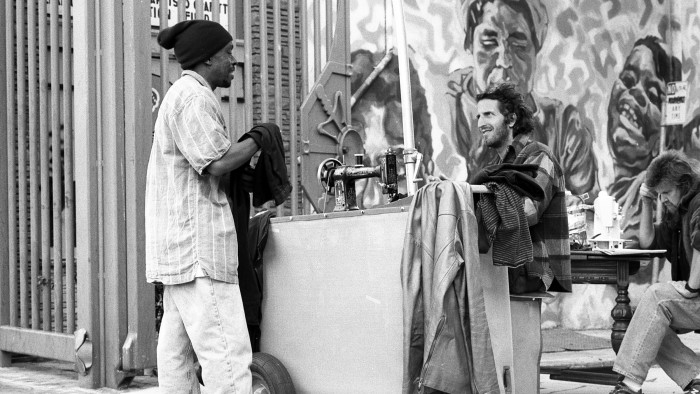
Summarize this content to 2000 words in 6 paragraphs in Arabic Stay informed with free updatesSimply sign up to the Sustainability myFT Digest — delivered directly to your inbox.I was walking through the streets of San Francisco in 2000 as a young artist when the idea for a sewing project was born. My friend pointed to an empty alleyway and said, “Michael, what would you do there?” A week before, I had driven by a house where someone had thrown out their old sewing machine. It gave me an idea that I could put the treadle sewing machine in the empty alley. It didn’t need electricity and I could mend clothes for the neighbours. I think I was partly inspired by a piece I had seen in Chicago as an undergraduate ceramics student. A collaborative group of artists had built a hydroponic garden, and grew leafy greens that they delivered to people who were sick with HIV (this was at the height of the HIV/Aids epidemic). I remember having an epiphany: art could be functional and it could have this bigger purpose. I only started sewing at college, but it runs in my family. My mom is really good at sewing, and she gave me some lessons and helped make things I wanted. My great-grandmother, Dorothy Heizer, made dolls with miniature outfits. We did some research and Dorothy turned out to be one of the most famous American doll-makers. Her pieces are in the Smithsonian. They were on display in our house when I was growing up, so part of my life was spent walking by this beautiful craft, and seeing her skill with a needle and thread.When I first tried mending, I just had a cardboard sign that said “free sewing”. I set up one day on Ellis Street in the Tenderloin neighbourhood of San Francisco. There was low-income housing on all sides. It was easy for people to say, “My shirt’s right upstairs, let me go get it.” Later, after I got a grant, I built a cart with a table, an umbrella, wheelbarrow wheels and a neon sign that blinked the word “sew”. I used to push it through all of these different neighbourhoods. And there was a little adventure where I went to London and did door-to-door darning. But the longest version of my “Free Mending Library”, as I called it, was outside the 509 Cultural Center (also known as the Luggage Store Gallery) in the Tenderloin. One day a month for 15 years, through winter and bad weather, I sat on the sidewalk with my sewing machine and mended clothes for free. Mending something is not just about the mend, it’s about the care for another humanThe neighbourhood took to it quickly. I’d hear people saying, “Hey, the sewing guy is back”, and they would have stuff ready for me to fix. One neighbour would bring peanut butter and jelly sandwiches down. Others would come and sit next to me in the chair by the machine and help me mend. I’d have a pile of things from different people that I’d be working through; I could usually fix about 30 things over the day. If someone brought too much, I’d tell them to pick out their favourites. I said no to a handful of things: to complicated jobs on fancy pieces, and to one guy who asked if he could bring a 20ft cover for his boat. Most of my mending was functional and quick. I realised that everyone has something that needs mending, whether they’re rich or poor. Even in the financial district, people were in fancy suits but they were still charmed by the sewing machine. Some of those people with better jobs would often say, “Oh man, I have this amazing jacket that means so much to me, but it’s at home and my house is way over there.” I got a lot of responses from people who wished they could participate but didn’t have the ability to go back home and get the piece of clothing right then and there. In the Tenderloin, it was the opposite. I learnt a lot about the different ways that people needed clothing. There was a Vietnam-war veteran who was always very friendly and would give me a hug. One day he told me that he mended his own socks, but that he just used a stapler to staple the holes shut. I was like, “Let’s take those off. I think I can do better than the staples.” You realise that people often relate to their clothes through a sense of need. All of the rips and holes told stories about real livesOne of my favourite visitors, Veronica, wanted to look like Jackie Onassis. She had a real vision: she brought a newspaper clipping of Onassis in a fur coat, and a sweatshirt and a piece of fur she found on the street. She wanted me to sew them into a jacket. She would often bring a suitcase full of clothes. I realised after a while that she came for the empty chair next to me, and for someone to listen to her and care for her. Veronica was one of the first people who reminded me that mending something is not just about the stitch and the mend, it’s about the care for that other human.There was also a Japanese neighbour, Tashi, who would bring things he’d hand-mended that he wanted me to strengthen with my machine. The truth is, he didn’t need my machine; his mending was perfect and beautiful. He was a sushi chef and he was very precise. But he would sit and hand-mend other people’s stuff while I did his project with the sewing machine. I learnt to say yes to any help that was offered. Being open-minded and letting the world help me figure out each scenario was a really good lesson.Through the wear in the clothes I could see how people moved too. Particularly in that area of town, people would wear pants that were too long and rubbed on the ground, and the hem would get all beaten up. I did a lot of hemming and a lot of that was about people wearing someone else’s pants because they almost fit. Some of the rips and holes I saw on people’s clothing would have obvious causes, and others mysterious. But all of them told stories about real lives. I’m the fourth of four boys, so I always had hand-me-downs. I would get so excited if I got to wear my oldest brother Jay’s jacket, particularly if it was already worn-in. Jay worked as a car mechanic and wore really beaten-up clothes. And then David, my second-oldest brother, went to Japan as a foreign-exchange student. He came back with all of these designer sweaters from the ’80s that you could never get in America. So I got to wear Jay’s beat-up Carhartt jacket and I got this fancy sweater from Japan. Both were equally powerful for me. I was this little kid who loved his older brothers and wished they would like him as much. I still love the story and the connection to another person that comes with a hand-me-down.For me, sewing is about that moment where you and someone else try to do something together around a piece of cloth. Almost all of the mending that I have done has been collaborative: about talking with the person who’s there with their clothing. The conversation usually starts with sewing but often continues on to something connected to their life. Over the years, I have had conversations about a loved one dying, living on the street or sharing food. Now I have a five-year-old son and that’s what I want to have with him: meaningful conversations around the mending. I still mend clothes for myself and my family, but the project is on pause at the moment; I’ve moved to Seattle to teach. But by chance I got an email the other week from the 509 Cultural Center saying they’re trying to start it back up. I’m excited for other people to mend, and if it feels related to my project, that’s wonderful.