




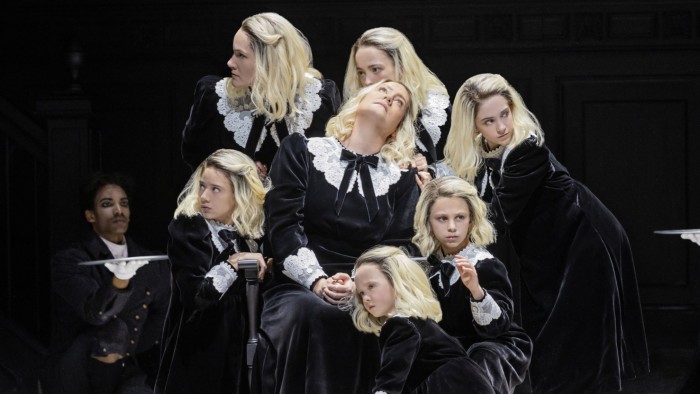
Summarize this content to 2000 words in 6 paragraphs in Arabic Unlock the Editor’s Digest for freeRoula Khalaf, Editor of the FT, selects her favourite stories in this weekly newsletter.Richard Strauss’s Salome was a true succès de scandale at its 1905 premiere and for some years thereafter. The Metropolitan Opera in New York took up the score in 1907, but the daughter of the financier and powerful board member JP Morgan was so outraged that it was withdrawn following a single performance and not heard again in that house until 1934. Today, directors often go to gratuitous extremes to preserve the opera’s power to shock, as Lydia Steier did for the Opera Bastille in Paris in 2022, in which the Dance of the Seven Veils was replaced with a gang rape.That Parisian staging was created for the South African soprano Elza van den Heever, as is the Metropolitan’s new production directed by Claus Guth, in his house debut. Yet, unlike Steier, who focused on the debauchery of Herod’s court, rendering it with a relentless display of gruesome acts, Guth turns the opera into a psycho-sexual examination of the origins of Salome’s depravity. With Etienne Pluss’s matt-black set imagining the inside of a vast Victorian mansion, the atmosphere is one of gothic horror. Guth rewrote many of Strauss’s stage directions to make his point. Before the music even starts, we see Salome as a young child playing with a doll. Even after the downbeat, as Narraboth, captain of the guards, sings longingly of Salome’s beauty, he’s still singing to this child — who’s replaced by van den Heever a few minutes later. As for debauchery, there are nude party guests wearing animal heads wandering on a landing upstage, but these seem a directorial afterthought. Instead, what’s truly shocking is the gradually unfolding suggestion of sexual abuse, culminating in the Dance of the Seven Veils, with which Salome demands that Herod give her the head of Jochanaan (John the Baptist). Here, the dance is performed by seven Salomes of ascending ages. It’s not at all what Strauss imagined (and there were some boos mixed with the cheering when Guth took his bow) but it succeeds in making Salome as pitiable as she is monstrous. The opening night crowd roared when van den Heever took her bow, and rightly so. Her Salome was every inch a damaged and demanding adolescent, aided by the hint of steel in her otherwise warm, pure tone. Peter Mattei brought a welcome hint of vulnerability to the righteousness of Jochanaan, although the amplification used to project his voice from the dungeon gave it an unpleasant, metallic edge. Gerhard Siegel’s Herod was more unhinged than lascivious, but a virtuoso display nonetheless, and Piotr Buszewski’s ardent Narraboth was another standout.Salome has been described as a tone poem with voices. At times, the balance between stage and pit was far from ideal, with several vocal passages nearly inaudible. But conductor Yannick Nézét-Séguin conveyed the score’s dramatic sweep, and also elicited the most polished playing I’ve heard from the Met Orchestra this season. ★★★★☆To May 24, metopera.org