




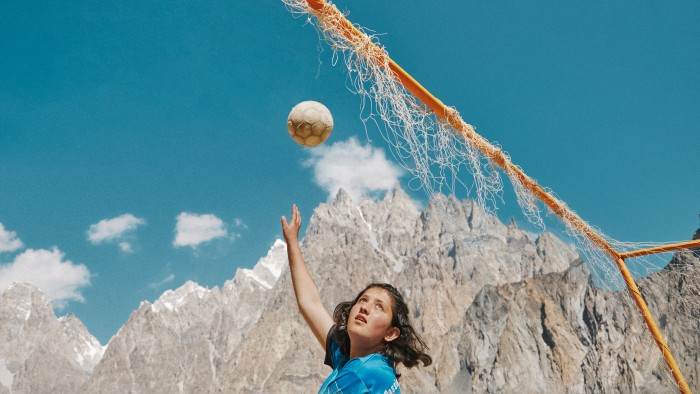
Summarize this content to 2000 words in 6 paragraphs in Arabic Unlock the Editor’s Digest for freeRoula Khalaf, Editor of the FT, selects her favourite stories in this weekly newsletter.At 3,100 metres, the air is thin. There is little grass and the trees that do grow are sparse, spindly things. It seems an unlikely place to hold a football tournament. But since 2018, the village of Passu in northern Pakistan has been home to the Gilgit-Baltistan Girls Football League for players aged 14-21. Each year, teams from villages across the region travel to the Passu Valley, in the shadow of the 6,000-metre peaks of the Karakoram mountains — the physical border between Pakistan, China, India and Afghanistan — to compete in the tournament.Sisters Karishma and Sumaira Inayat, who were born in 1998 and 1995 respectively in the nearby village of Shimshal, founded the league out of love for the game and as a way to inspire other young women. In Pakistan, women’s access to sport is restricted by the same cultural and religious barriers that exist in nearly all walks of life. Shimshal, however, is in Hunza district, where the majority of the population are Wakhi, an ethnic group known to be relatively progressive, with a focus on women’s education and equality. Yet organising a tournament of this kind in northern Pakistan was not straightforward.Spanish photographer Anna Huix first came to the region in 2013 while working on a story about gemstone miners. A couple of years later, she began researching a story about female Alpinists. “The Karakoram is a place where lots of Alpinists from all over the world go to open new routes,” she tells me. “I came across this other story [of the girls’ football league] and I fell in love with it.” Huix made contact with Karishma on Facebook. After a couple of years of messages and calls, she got on a plane to Pakistan in October 2023, the last month of the year when access to the region is reliable. After October, winter starts to take hold and the roads become impassable.Huix arrived in Shimshal knowing she would make a film. What began as an idea for a photo story had morphed into something bigger when a friend of hers, a documentary filmmaker, saw the hours of interviews Huix had done with Karishma and Sumaira via video call before flying out to meet them, and suggested she make a short documentary. The resulting film is Girls Move Mountains, a 21-minute short now touring the festival circuit.Karishma and Sumaira fell in love with football when they moved from Shimshal to Lahore as children. It was the first time they’d seen women or girls playing football, and they wanted to get involved. It instilled in them a sense of pride and independence, but also of fear. “Our neighbours would come to my father and they would tell him, ‘Why are your daughters wearing trousers and shirts, and why are they going out of the house without a dupatta [headscarf]?’” Karishma says in the film. At times they were harassed and pushed in the street. “But somehow, we just got used to all the bullying . . . We got so strong that we didn’t really care much about anything.”Living in Lahore allowed them to get a good education and start considering their futures, but their thoughts were never far from Shimshal. Most of their family still lived in the village, and on their regular trips back the pair started dreaming about setting up a football tournament there.There were hurdles to overcome. “No matter how open-minded a community is,” Karishma says, “there are always some boundaries that [men] have set for women.” Even after the authorities had agreed to the tournament, not everyone in the community was convinced. The girls received a barrage of abuse online, and there were street protests in the more conservative parts of the district. Religious leaders threatened to storm the pitch to stop the matches, describing the tournament as a “pornographic, exhibitionist event”. The sisters had to organise for armed police to protect the players, and no spectators were allowed until the final game when, after four days of competition, they felt confident enough that there wouldn’t be any trouble.It is still common for girls to marry young in parts of Pakistan, particularly in rural areas. “The main problem in my village,” says Karishma, “is that when girls are 18, 19, and when their parents aren’t able to get them educated or pay their fees, they think it’s a good idea to get them married, so their husbands can manage the rest of their life. We want this to be finished. We want to give them a purpose. Some can get admission to university on sports scholarships.”Huix tells me about the lengths the sisters have gone to not just to secure the funding for the tournament, but to extend the invitation to those who might benefit most. “What Karishma really wanted was for girls who come from more conservative backgrounds to be able to attend the league, so that they are in contact with other girls who are a bit more open-minded, who want to study or to be more independent. And in a few places, Karishma has gone to girls’ homes to convince the family to let the girls play.”In one of the most tender moments in the film, Karishma’s grandmother reassures her as she brushes her hair. “Yes, some people will oppose,” she says. “Many will be jealous. But some will appreciate. You don’t have to stop. You have to focus on your mission.” What comes through most strongly is the sisters’ strength of character. “Our hard work will pay off,” Karishma says towards the end.She is now in Paris, having received a scholarship to complete an MA in sports management. It’s opportunities like this that are really the aim of the league. To give the girls who take part a glimpse of a bigger world and the possibilities that might be out there.Josh Lustig is picture editor of FT Weekend Magazine. “Girls Move Mountains” is currently touring film festivals; annahuix.com/girls-move-mountainsFind out about our latest stories first — follow FT Weekend Magazine on X and FT Weekend on Instagram